Showing posts with label Culture. Show all posts

19 January 2017

How Dare We !!?

Do not gloat when your enemy falls;
when they stumble, do not let your heart rejoice,
or the Lord will see and disapprove
and turn his wrath away from them.
(Proverbs 24.17,18)

I'll never forget how physically sick I felt the day a dangerous individual who had harmed others and sinned greatly died, or more accurately - was killed, and my Facebook feed was littered with celebration.  Many rejoiced saying that said individual deserved even worse than the consequences already received.

True enough. I really can't argue that.

Justice HAD been served.

The celebration, however, broke my heart. To know that a soul, one most likely not prepared to stand before God, had entered eternity unprepared? No longer did any opportunity exist for a change of heart for that individual. And people who love Jesus with abandon apparently felt no sorrow that a soul was now condemned to hell.


Actions have consequences. Absolutely! 

In fact, the consequences of my actions make hell a just destination for me, but for God's mercy and grace.

Sometimes I forget that. 

When I get all caught up in the hating of an antagonistic adversary or despicable foe, I totally lose sight of the fact that the only reason I only look any different in God's eyes than does "my enemy" is that because He sees me clothed in Christ's righteousness. Somehow, I start suspecting that my own righteousness and efforts are impressing the Almighty, if only just a little bit.

When that mindset creeps in, when I realize that I'm glad - rejoicing and celebrating because of another's 
  • tottering,
  • wavering and weakening where there was once strength,
  • stumbling and falling,
  • fainting,
  • bereavement, 
  • being cast down, 
  • decaying, 
  • failing, 
  • feebleness, 
  • ruin
  • death?
I do not please God.


The only thing I can think of that begins to compare in my own life is when I see one of my children delighting and gloating in the deserved comeuppance of a sibling. Discipline is necessary and so critical as parents disciple children, but it pains to see one I love so much suffering through shame, guilt, conviction and/or consequences. 

It pains just as deeply, though, to see another one of my children enjoying their sibling's sadness, making merry as another reaps the aftermath they've brought on themselves. The more godly response would be sober sorrow.

Sober sorrow, however, must be the evidence of God's grace. This proverb warns, "Do not let...," words which remind me that rejoicing in another's just consequences or punishment is the natural and worldly-fleshly-sinful response. 

It is God's unfettered grace that enables His own to "not let" rejoicing ensue at the demise of a real or perceived enemy and to genuinely sit awhile with sober sorrow.


1st photo credit: adedip via photopin cc
2nd photo credit: Amarand Agasi via photopin cc
*originally published here, and slightly edited  and republished here.
Still convicting thoughts I regularly need to revisit, so revised and published once again..

19 July 2016

that "action of bringing two parties face to face"

So... that doesn't sound so bad, does it?

I mean, there are lots of times I really like being face to face - with my hubby, for one.


Or sitting across the table from a good friend, sipping tea or coffee and having to lean forward... in close... to actually hear what my friend is saying because the concrete walls echo, magnifying the background noises of all the other conversations taking place in the restaurant.


Or my littlest munchkin smashing her nose and forehead against my cheek, her preferred mode of snuggling as she falls asleep. It IS sometimes suffocating, but always sweet. It's also really hard to snap a picture of that, but trust me... it happens at some point, every single day... still. She's not always falling asleep, but at 7.5 years, she still needs a snuggle cuddle every day.

How, then, could it be? 

That a word defined as the "action of bringing two parties face to face" strikes dread in the hearts of so many. 

That it is something most of us (siblings don't count) avoid it at all costs. 

Or...

we simply strive to avoid those people who don't choose to...


...avoid [this word], I mean.


Have you figured out what "it" I'm talking about yet?

+
+
+
+
+
+
+
+

CONFRONTATION!

Conflict, altercation, disagreement, and argument are all common synonyms.

Or, more idiomatically,

"going nose to nose"
and
"butting heads!"

The etymology of the word confrontation, 

     which originates in the Latin and probably made its way into English via French, 

           looks something like this:


Essentially, it means the act of (according to dictionary.com)
  1. standing or coming in front of; 
  2. standing or meeting, facing; 
  3. presenting for acknowledgment, contradiction, etc.; 
  4. setting face to face; 
  5. bringing together for examination or comparison; 
  6. facing in hostility or defiance, opposing; and/or 
  7. being in one's way. 
Some of those have clear negative connotations... but they don't all have to, especially if we'd take the time to learn how to "do" well this thing we are calling confrontation: first how to receive criticism/confrontation... and then why, when and how to actually confront another.

Biblical confrontation was a topic I studied in depth with the women in our church in Niger. The pastor's wife asked me to lead a study on this topic because the younger women were intimidated by the older women, particularly when the older women let the younger gals know they hadn't met "some" expectation set by the older ones.

Here's what we looked at ~
Check out these links above if you want to see how our conversations/studies went. Personally, I felt I learned a lot more than I taught, and in those posts, tried to include the very interesting and insightful implications, as well as the conclusions drawn and applications suggested - all by the ladies in that church. One thing I think is important to remember - most of these women were, at that point in time, illiterate. Thus, it was quite likely their first exposure to some of the different Bible passages, in any way, shape or form.

I love the example of Nathan (as confronter) and David (as confrontee), in 2 Samuel 12. Nathan confronted gently and well, as well as for the right reasons. David received that confrontation humbly and brokenly. But then...

But then, we read 2 Samuel 13, a horrifyingly difficult account in the Biblical record. 

In chapter 13, we also read a story of several additional confrontations... or ones that should have taken place... 

Sadly, none of which were handled correctly by both participants, if they were handled at all.

As was my typical strategy when leading a Bible study, we read/reviewed the story. Then I asked them to identify any confrontations that did occur... and then to think about and identify where confrontations might have/should have occurred. The goals was to consider and then discuss:
  1. what went well (if anything), and particularly,
  2. what didn't go well 
between the confronter and the confrontee in each situation.

Here's what the ladies notices as we worked our way through the first half of the chapter.

A confrontation between Jonadab and Amnon


The two were cousins and apparently close friends. This confrontation actually started off okay. Jonadab showed himself to be an attentive and observant friend. He clued in to Amnon's distress and went to him, confronting him, saying "It's obvious something isn't right. Tell me what's going on." 


Amnon's initial response was also good. He very transparently answered his cousin and told him the whole truth of what was bothering him: Amnon desired his half sister. 


This was the point where I, from my perspective and with my cultural baggage, felt this encounter went wrong. Instead of encouraging Amnon to seek counsel, or instead of giving good advice himself, Jonadab recommends deceit and a selfish pursuit of what Amnon thinks will make him happy. Jonadab suggests an immediate and temporary alleviation of Amnon's discontent, rather than digging deeper to find out why Amnon was feeling as he was, instead of seeking lasting answers and a changed heart. Jonadab also recommended what could appear to be a deceitful ruse.

Thankfully, I held my tongue and allowed the ladies to speak first, because in the Nigerien culture direct confrontation rarely happens.

Instead, the women quickly pointed out a difficulty in judging with knowledge - completely and accurately determining Jonadab's motivations behind his counsel.


Here's what the ladies thought:

Jonadab's counsel provoked a visit from King David, Amnon's father. David clearly had the authority to confront Amnon - from a position of wisdom and personal experience (Temember the previous few chapters?). Whereas Jonadab could only address Ammnon's issues as a peer, David could speak as a father. Culturally, Jonadab could not directly confront his friend, but he could suggest a scenario where one, David, who legitimately and authoritatively engage would be made aware of the issue.

Out of curiosity, when I got home I looked up the meaning of the key word used to describe Jonadab: "shrewd" or "crafty." Hearing those words, I can quickly conclude deceitful.

However, the original Hebrew word meant wise and was often used in conjunction with prophets and those who had good discernment. It was also frequently used to describe sorcerers and false prophets.

My next step was to see what else, if anything else, the Bible says about Jonadab. He is mentioned in one other place - he accurately informs David of Absalom's revenge upon Amnon.

Thus, at least at a cursory glance, it appears that there are three plausible interpretations of Jonadab's actions: 1) he immaturely counseled his friend to use deception to get what he wanted; 2) he wisely set up a scenario where a more qualified person could potentially confront Amnon regarding his foolish desires; or 3) he was no true friend to Amnon, engaging in, for whatever reason, a sophisticated subterfuge, using royal court liaisons to remove a potential successor to David's throne.

Thus, what did we learn through this example of "two parties coming together, face to face?"

Confrontation can be done in many different ways, and probably should be, depending on the circumstances and need. 


We had already seen the example of an indirect confrontation by two who might be considered equals - King David and Nathan.

That day, we had looked at another confrontation - perhaps between equals (two friends) or perhaps between two unequals - the king's son/potential successor to the throne and the king's nephew. That day, the ladies tended to see Jonadab's actions as wise - indirectly confronting by bringing Amnon into a position where his father would better be able to confront his inappropriate, sinful desires.


What do you think?

Does one of these interpretations seems most plausible to you? Which one?

What is your reaction to women from a different culture understanding a Biblical passage differently than what you may have traditionally been taught, simply because they come from a different cultural context?


Trying to give credit where credit is due:
from whence came that title 
here's where I found that picture of the rams-butting-heads-statue
originally posted here on July 19, 2012

22 May 2014

"...It’s not my job to write my daughter’s future" - agreed... and perhaps more importantly, disagreed - because of the context...

"...it’s not my job to write my daughter’s future. 
And it’s not her job to live up to my dreams for her."

I read that statement in a post on one of the blogs I regularly read... and it evoked a rather rabid love/hate response deep within my heart, enough so that I felt I needed to respond within the comment section. 


Let me start off by saying that Mr Irwin's post was written in the context of discovering that one of your children has chosen to pursue a homosexual lifestyle - and that under those conditions, parents need to let go of the dreams they had for their child - dreams that centered on their son or daughter getting married to someone of the opposite sex, having children, raising a traditional family. It was disheartening to read the post and the comments section. Both clearly reveal the about-face many of those who self-describe as evangelical Christians have made regarding God's view of marriage as the basic building block of family, God's sovereignty over every aspect of their lives, and a blatant disregard for the Bible and its very relevant and pertinent application to lives today.

But first, here is my response:
Can I say that I both love and hate that statement at the same time... 
because I both wholeheartedly agree and disagree at the same time? As a parent wanting to see my children grow up and love God with all their hearts, minds and souls and to love their neighbors as themselves, I think our "job" or "ministry" or "training" or "raising" of our kids involves at least two important aspects that directly relate to this question: 1) As parents we are to help train our children in the way that God wants them to go... or, in other words, help them to discern what God's dreams are for them and their future; and 2) in doing that, our own dreams for them will clearly "grow" or become more "defined" as will their own dreams for themselves.
The bigger question is am I willing to teach my kids to dream, to dream big and to work hard for that dream but to hold their dreams with an open hand if God begins to direct them to a different dream, or as they discover that perhaps their dreams are contrary to God's way... and to submit their ideas of what is best to God's revelation of what is noble, right, pure, lovely, admirable, excellent and praiseworthy. The best way for me to do that is to model holding my dreams... for myself... and for them... with that metaphorical hand open and lifted up to God - and to submit those dreams to God's sovereignty and absolute right to our futures - whether we understand or not.
And that's where I totally agree with your statement quoted above. It isn't my job to write my children's futures - that belongs to God. It isn't their job to live up to my dreams for them. It is their privilege to be obedient and submit to the future and dreams God has for them - whether it matches up with what I thought, or what they thought... at first.
Let me re-iterate those last points ~
  1. God "writes" the futures of my children. He created them, He gives them every breath and heartbeat, He preserves their lives. They are His.
  2. My children are not responsible to live up to any dreams that I may have for them - but IT IS THEIR PRIVILEGE, by the power of grace, to be obedient and submit to the future God has scripted for them, regardless of what they feel they want their futures to look like.
That future that God scripts will never include something that violates God's Word or His holy nature. 

If my child chooses to pursue such a path - it isn't my job to change them. It certainly isn't my job to try and convince them to go back to those dreams and imaginings I had of them and what their lives (and mine, as a result) might be like.

It is, however, my job to continually, unceasingly point them back to the One Who will teach them to discern sin and false teaching, empower them to change and walk away from it... and Who will grace them with His strength to righteously live with any "thorn" He has given.


20 May 2014

~ Sobering, Scary... and Rings SO True ~

I don't remember where I first saw this title, exactly what prompted me to get a copy of this book, or how long I've been slowly working my way through it,

...but doing so has taken me on a HUGE learning curve.


NARCISSISM ~

inordinate fascination with oneself; excessive self-love; vanity.
also: self-centeredness, smugness, egocentrism.

There's even something called Narcissistic Personality Disorder (NPD), or a condition in which people have 
  1. an excessive sense of self-importance, 
  2. an extreme preoccupation with themselves, and 
  3. a lack of empathy for others.
It was one of those words I'd heard, and certainly understood when I read it in context, but not one that I'd spent much time thinking about, until recently... until reading this book.

Basically I was hooked from the moment I read the following words: 
"Personality does not exist in isolation. This increase in narcissism in individuals is, we believe, just an outcome of a massive shift in culture toward a greater focus on self-admiration. Narcissism has spread through the generations like a particularly pernicious virus - one with multiple means of entry and transmission. First, Americans' immunity to narcissism has weakened. At one time, strong social pressures kept people's egos in check. Mothers asked children "Who do you think you are?" (instead of "What do you want for dinner, princess?") Religious leaders stressed humility and modesty. Strong communities and stable relationships discouraged arrogance and made it less necessary to meet and impress new people. Narcissism has also been transmitted as an unintended consequence of good intentions, as in the self-esteem movement and less authoritative parenting. Instead of creating friendly, happy children, however, these practices often produce self-centered, narcissistic young people. 
In addition, norms for self-presentation have shifted with cultural trends and new technology.... Internet social networking sites and celebrity culture have raised the bar for narcissistic behavior and standards. Using MySpace [or Facebook] to post a picture of yourself half naked and posturing provocatively is now considered totally normal -- even though it is also deeply narcissistic. Americans are being persuaded that becoming more vain, materialistic, and self-centered is actually a good thing. This can happen even if you're not particularly narcissistic but just get drawn into what everyone else is doing. Today, if you don't get your teeth whitened, everyone thinks you are either poor or an espresso-drinking, cigarette-smoking European. Ten years ago, nobody would have noticed." (pp. 38-39)
This book is a difficult read, if you are willing to ask yourself hard questions as you make your way through the text - especially when the authors identify what their research has revealed to be the "root causes of the epidemic:" 1) current parenting and teaching practices focusing on the uniqueness and the special-ness of each child; 2) current obsessions with celebrities and everything about their lives; 3) social networking sites and the the quest for attention and self-promotion of a carefully crafted image; and 4) easy credit and never allowing real consequences to play out because of the mentality that "I deserve the best right now, regardless of the cost or future consequence!" 

This book is a scary and sobering read, especially when you see symptoms of narcissism stealthily creeping or full-out lambasting their way into the lives of those you love, into the organizations with which you affiliate. What are those symptoms? They include a growing focus on self-importance and a beautiful, appearance often at the expense of genuine caring or sweet personalities (i.e. vanity), materialism, the insistence on believing that "I'm special and therefore better or more deserving...," increasing acceptability of antisocial behavior, less and less civility and insistence on "my rights" instead of learning to get along, feeling entitled, and serving not to help others but to help your own image and self-impression.

Having spent most of the past fifteen years living on the backside of the Sahara Desert, while not immune or insulated from all of these pressures, we can clearly see the symptoms more and more pronounced each time we return to the States. It is revolting, especially as you listen to people you love and trust and admire... as you hear your own thoughts... justify behaviors the Bible clearly condemns. We, as a society, are so busy loving and worshiping ourselves, there is very little... if any... room left for God. We've made life into an "All about me" sort of drama, on so many levels. And frankly, this is what terrifies me the most about bringing our family back to this world... it is what concerns me when I ponder what it will mean to raise the younger half of our family in this world and culture so that they can function as aware and relevant - but without losing them to a value system that is so far from what God created us to be. 

It is the researched opinion of the authors of The Narcissism Epidemic: Living in the Age of Entitlement that, "As a society, we have a chance to slow the epidemic of narcissism if we learn to identify it, minimize the forces that sustain and transmit it, and treat it. If we are unwilling to make... changes, reality always wins in the end. The only question is how long it will be before our nation buckles..." (p. 302-303)

photo credit: deborah is lola via photopin cc

03 August 2013

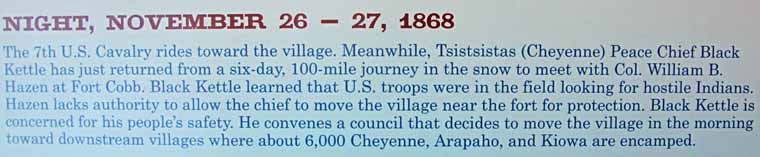
Westward ho! ~ @ the Washita National Battlefield Historic Site


A few years back, one of our girls was given the complete set of Dr. Quinn Medicine Woman videos. We've since watched the series several times and one of the all time most compelling episodes, in our opinion, occurs at an Indian encampment on the banks of the Washita River.


This Day in History describes the events of November 27, 1868 like this: 
Without bothering to identify the village or do any reconnaissance, Lieutenant Colonel George Armstrong Custer leads an early morning attack on a band of peaceful Cheyenne living with Chief Black Kettle. 
Convicted of desertion and mistreatment of soldiers earlier that year in a military court, the government had suspended Custer from rank and command for one year. Ten months into his punishment, in September 1868, General Philip Sheridan reinstated Custer to lead a campaign against Cheyenne Indians who had been making raids in Kansas and Oklahoma that summer. Sheridan was frustrated by the inability of his other officers to find and engage the enemy, and despite his poor record and unpopularity with the men of the 7th Cavalry, Custer was a good fighter. 
Sheridan determined that a campaign in winter might prove more effective, since the Indians could be caught off guard while in their permanent camps. On November 26, Custer located a large village of Cheyenne encamped near the Washita River, just outside of present-day Cheyenne, Oklahoma. Custer did not attempt to identify which group of Cheyenne was in the village, or to make even a cursory reconnaissance of the situation. Had he done so, Custer would have discovered that they were peaceful people and the village was on reservation soil, where the commander of Fort Cobb had guaranteed them safety. There was even a white flag flying from one of the main dwellings, indicating that the tribe was actively avoiding conflict. 
Having surrounded the village the night before, at dawn Custer called for the regimental band to play "Garry Owen," which signaled for four columns of soldiers to charge into the sleeping village. Outnumbered and caught unaware, scores of Cheyenne were killed in the first 15 minutes of the "battle," though a small number of the warriors managed to escape to the trees and return fire. Within a few hours, the village was destroyed--the soldiers had killed 103 Cheyenne, including the peaceful Black Kettle and many women and children. 
Hailed as the first substantial American victory in the Indian wars, the Battle of the Washita helped to restore Custer's reputation and succeeded in persuading many Cheyenne to move to the reservation. However, Custer's habit of boldly charging Indian encampments of unknown strength would eventually lead him to his death at the Battle of the Little Bighorn.


The dimensional, topographical map at the museum also details the events of that day. I think Jonathan must have read every word, soaking in the history. (If you can't make out the words, click on each individual photo. It should make the photo much larger.) 


We also found the quotes, pictures, paintings and video (with re-enactment) sobering and sad...


It leaves me wondering in what areas we are equally blind today -
 even when we're sure we're in the right...


I don't think our family is the only one that has every wondered, asking those sorts of questions?

Have you?


11 June 2013

It was one of those moments...


It was one of those moments  -- absolutely impossible to replicate… ever.

And yet it was so beautifully simple.

Leaving the recreation center (where we sometimes retreat for pool time or a couple of hours hanging out watching satellite TV in an air conditioned room), we noticed a huge gathering of black kites hunting something, gliding and drifting, plunging then lifting – over the softball field. Instantly mesmerized, the entire family stopped and watched, our eyes glued to the sky and the movement of those graceful birds, hoping to determine what was the cause of this large gathering of birds of prey.

Then I allowed my eyes to drift back toward the green grass of the infield. 

My littlest one had wandered out, wearing nothing but her swimsuit in several hues of neon, and there she stood. Or, more accurately, there she slowly turned, round and round, head tilted back, eyes skyward, totally absorbed and totally fearless, immersed in the drama taking place just above her. At least fifteen birds, many with wingspans nearly twice her height swooped and dove all around her. Two, in fact, literally collided only feet above her head. The birds pursued recently hatched termites, oblivious to their audience...


Please join me over at my new friend, Rachel Pieh Jones' place
She is an amazing woman; it has been such a joy to get to know her a bit this past year.
She writes at Djibouti Jones (as well as several other places) 
and I'm humbled and honored (and totally overwhelmed) 
that she has invited me to post as part of a series:

14 May 2013

Aliens and alien cultures

After a doozy of a start, this hot season has, thankfully, fizzled into something still uncomfortably warm and lots of sweaty, drippy days... but really, on the whole, pleasantly bearable, at least compared to the usual. 


See their smiles?

I still find it amusing to skim through my Facebook feed on any given day, though, because:
  1. Friends from our part of the States are either freezing as they wait for Spring to really and truly arrive or they are jumping for joy at the warmth of a 80 plus degrees kinda day.
  2. Friends from our part of Africa are praying the electric stays on because by 9 a.m., kitchens are already hotter than 90 degrees.
Some days, it is like culture shock, the mental jumping back and forth between these two worlds....

Because in our Michigan - American world, approaching 80 (27'C) degrees is SUMMER TIME... out come the motorcycles, shorts, sandals and flip-flops, picnic baskets, sunscreen... off go the pool covers and convertible car-tops... on switch the fans and air-conditioners.

Meanwhile, in our Niamey - African world, descending near 70 (21'C) degrees is ALMOST BUT NOT QUITE FRIGID... out come the shawls, winter jackets, socks, knitted hats and scarves, sweatshirts... closed go the louvered windows and doors, all openings into huts are covered by metal pieces or plastic tarp... in go the mats, mattresses and mosquito nets as people seek warmer shelter, particularly to sleep.

All of THIS happens within the same 10 (6'C) degree temperature range.

Amusing. 

But it also has me thinking about a same but different sorta situation.

No one adamantly says one is RIGHT (considering 70-80' warm) while the other is WRONG (considering 70-80' as too cool to be comfortable). They are just different  perspectives based on a different reality. So we just smile and  sometimes roll eyes. Usually.

So why do people so quickly label certain cultural (or church) practices that are different from their own as WRONG, or SINFUL, or GOD-DISHONORING rather than simply different?
  • Heads covered or not?
  • Music styles appreciated and enjoyed?
  • Instruments used in church?
  • Families together, sexes together or age segregation during worship?
  • Sabbath keeping... even how it is done?
  • Activities chosen for leisure?
  • Arranged marriages or not?
  • Family size?
  • Educational decisions?
  • Teaching methodology?
  • Etc...
There are some things that God's Word qualifies as non-negotiable. 

Those non-negotiables are probably a lot fewer that what some of us like to insinuate... and significantly more than a whole other group of us like to import. After all, God has given man the freedom to choose and that includes choosing how we apply His Word in our day to day lives. 

In the long run, I'm believing it is more important that someone is studying the Word , that someone is seeking to live life applying principles showcased within, and choosing to trust that the Holy Spirit can incite enough sincerity that those someones (myself included) recognize when God points out something is wrong.

The biggest question seems to be:

Who will choose humbleness, accepting both differences and correction, and then seek to change when/if God works that way?

****************************************

What do you think?

***************************************

04 February 2013

In the Face of Deep Disappointment


“Men and women enter ministry for various reasons.  ‘Because I want to be a deep disappointment to others as well as to myself’ is rarely listed among them.”
~ Jeff Manion, The Land Between


Why are you, as an international worker [or anyone, really], doing what you are doing?

And do you feel as though you are accomplishing what you’ve set out to do? Or do you fear you are not only disappointing yourself, but others as well? Why?...

---------------------------------------

Please join me today at a life overseas: the misions conversation where I discuss a common pitfall, at least for me - trying to make sure I "measure up" to some impossible and idealistic standard. 

And be sure to hop right in to the conversation. Hope to see you there!

26 January 2013

And so what would you do if _____________ ?

Tim and I had one of those provoking lots of thinking questions detonate out of rather inconsequential conversation the other day...

...and so I decided to bring up the questions here, to ask you what you would do in a very "different-to-most-western-Christians" circumstance.

But first - a bit of context. 

In general, every 2-4 years, missionaries tend to return to their home countries for a year of home assignment and packing up your belongings, selling or storing them, deciding what to take and what to leave, etc., etc., etc., It tends to be a rather long, drawn out process done in bits and pieces all throughout the last 4-6 months on the field and often starts with the purchase of plane tickets.

We recently bought ours and we've started telling friends, colleagues and neighbors that we will be leaving after Brendan's graduation for some time back in the States. Last Sunday, Tim shared this with our local church family and reminded them to continue praying for all of us and the security situation in this part of the world. 

Our pastor started to tease Tim a little, asking "What people who couldn't leave should do if the situation in our immediate locale deteriorated." 

Tim mentioned one of the older men in the church, a man who has worked much with Tim at the studio recording the Bible on audio tape, and commented: "we'll have room in one of our suitcases." 

Then the pastor replied, "But what about your friend's two wives?" 

Tim jokingly answered that we probably had enough suitcases....

And that was the end of the exchange at church, but when Tim told me about it later that day (I wasn't at the service... home with sick kids, AGAIN), I started trying to picture what it would like to take our friends to our home church (not literally in suitcases), introduce them to our friends in Midland, and wondered how both they and our western friends would respond to each other. Questions rifled through my mind.

"Tim, what do you think people from our church and community would do if we showed up with this family, brothers and sisters in Christ, but also in a polygamous relationship?"

"How do you think our friends and families back in the States would respond to this couple? To us as friends of this unique to Michigan sort of family?" 

"Would we [Tim and myself] change how we act towards them removed from this situation where their lives aren't so unusual and placed back into a world where their family is not even recognized as a legal, valid choice?"
**************************************
This leaves me with two questions for you: 

1) What do you think your initial and then longer-term responses to a family such as this might be... and how does thinking about your response make you feel?

2) What do you think such a family, immigrating or moving to North America and seeking a local church family, would need to do? 
What would you encourage them to do?

*****************************
One additional note and one additional question: 
Our friend had married two women many, many years before he decided to follow Jesus. Now both his wives and most of his children also know the Lord. In some senses, that detail is an important part of this discussion. But in other ways, it is not - if the question is simply one of learning to be hospitable to those seeking to follow Jesus, wanting to know Him more and better and be a part of a church family even though they may live in a way or engage in behaviors about which we feel very strongly... about which we are convinced of their wrongness. How do we encourage and build up others, entering into dialogue and  fellowship with people whose Christianity looks different because their culture and world looks so very different? 

LinkWithin

Related Posts with Thumbnails