Showing posts with label Good preaching. Show all posts

12 March 2018

Blown Away

You know, there are at least 153 synonyms for that expression. I just looked it up. Of course, that includes many different nuances, not all of which are applicable to the sense in which I'm using it tonight, but still...

I digress.

Sunday, the sermon at church was drawn from a passage of the Bible that I love. It's a passage I've studied and taught several times and the lessons drawn are always fresh, always applicable, even though they're old lessons , they are still things I'm still in the process of learning. Maybe I'm just a slow-learner, but I'm starting to expect that from God's Word. 

After all, truth is always truth 
and 
God's truth never becomes trite or cliche 
when 
I approach it with a teachable spirit.

So, as I said, this passage and I have a history (more than 10 years worth, now). It's one of the first passages of Scripture that I memorized: "Amma goy-teerey kaŋ na haro kaa wo bay... " Yohanna 2.1-11(in Zarma), so that I could teach a ladies' Bible study at the church we attended - so I'm probably a little sentimental, too.


So what passage is it? 

It's Jesus first miracle, performed at a wedding in Cana, and found in the beginning of John 2. 

I always used to wonder why this was the first miracle John recorded. But the richness of the lessons in this account - and they just keep piling up - well, blown away! Those are the words that come to mind as I try to describe how I feel as I meditate once again on these words. 

I knew it was coming up, as our pastors are preaching through the book of John right now. And I was looking forward to it - because I was sure I'd learn something new.

First, a quick review, though:

We don't know why Jesus and his mother were at the wedding - most figure it was family, or friends like family. But this passage first began to make sense after I'd attended a few weddings in Niger. Culturally, 1st century Jewish weddings were much more similar to how weddings are celebrated in there than how we "do" weddings in the West. First, the civil ceremony, then a celebration after can last several days. Anyone walking by can decide to attend - and expect to eat and drink. There is no way to know exactly who or how many will attend.  But beware: Running out of food at a huge fête generally leads to shame and embarrassment. Similarly, running out of wine at the wedding in Cana would have been shameful and humiliating for the host family. 

I love how Mary knew she could come and share this need with Jesus. Clearly, there was no doubt in her mind that there was something very special about this man she'd watched grow from a boy: His birth announced to her by an angel, the incredible circumstances of His arrival and the ensuing hullabaloo, His wisdom and ability to teach learned ones in the temple as well as other things that she would have certainly seen as He grew up in her home. The Bible tells us she had the habit of gathering these things up and pondering them in her heart (Luke 2.19). Mary knew her son was unique and very extraordinary, but did she realize just how special? I don't think even she could have recognized the significance of all that He had come to earth to do. Yet she knew Him well enough, and had sufficient confidence in Him that she knew she could bring this need before Him.

Jesus responded to her... I love that fact. Do you ever wonder what Mary might have thought He'd say? I imagine the answer she received was probably not exactly the one for which she was hoping. But He heard her and He did respond. The things that concern us concern Him, too. And He will respond for the best. 

Mary somehow understood this, because while Jesus' response may not have been what she was hoping to hear - she trusted that He would do something and that what He would do would be right. Thus she tells the servants, "Do that which He will tell you to do." Seeing this side of Mary's faith in Jesus both challenges and encourages.

Six stone vases... each able to hold about 120 liters... 

Jesus told the servants to fill them with water. They filled them up to the brim! I love that detail. Servants are usually quite in tune to what's going on around them. They "sense the vibes." Perhaps they picked up on Mary's confidence in her son. Maybe they were just exceedingly obedient and did exactly what they were told. The Scriptures don't give that detail, but for whatever reason, they filled those vases as full as they could... and that allowed others to receive a blessing.

Sandy Winter wrote these words about Jesus' response: "Jesus chose an act ...truly extravagant and exaggerated.... We would have thought that Jesus would recommend moderation. What does it mean, then, that He responded so excessively? 720 liters of rich and intoxicating wine...? This, then, is the true question. What was He trying to demonstrate by His nearly scandalous extravagance in this, the inaugural event of His ministry,... especially knowing that later miracles would deal with desperate needs: healing, provision, security, life?"[1]

Why? 

Why would He love to delight by responding extravagantly to even seemingly insignificant things (in the grand scope of life) that concern us? Think back to the first time we read of a miracle where water is changed into something else. God, working through Moses, changes water into blood, ushering in law and judgement. This, the first miracle of Jesus, the Lamb of God who came to usher in salvation by grace, was water changed into wine in super-abundance. Jews familiar with the Scriptures would have understood that this abundance of wine heralded a celebration for the Messiah's arrival. (See Amos 9.13,14 & Isaiah 25.6-10.) The passage does later say, "He manifested His glory and His disciples believed in Him." And, of course, we can't forget Revelation 19 - a wedding supper no one will want to miss, the Wedding Supper of the Lamb.

Or was His motivation simply because He loves and it was within His capacity and His Father's will to give such a gift?

Whatever the Savior's reasons, the man coordinating details for this wedding was astonished. Not only was there an abundance of wine, but it was really high quality stuff. It impressed him and he called the bridegroom to essentially ask, "What's up? No one goes about it this way..." He doesn't get an answer, for the bridegroom did not know.

No one knew except for one particular group of people: "...the servants who had drawn the water knew very well..."

It was this phrase that first grabbed my heart as I began studying this passage. I want to see my Lord working miracles. I want to see them regularly.  Thus I need to be in a place of humble, unquestioning service, doing that which He tells me to do.

From this Jesus encounter come five applications that touch my life almost every single day: 
  1. I can approach the Lord with whatever need, big or small.
  2. Jesus will respond.
  3. I can have confidence in Him - whatever His response, whatever He chooses to do, it will be very good.
  4. Jesus' responses are often extravagant - far and above what I might imagine or dream up on my own. He lives to demonstrate His lavish love.
  5. To see God working, I too must be found in the heart position of a servant - immediate and unquestioning obedience.
It's that last one, there, that usually hits me square between the eyes on an almost daily basis, challenging me to remain teachable, humble, gentle...

But, as the preacher taught from this text last Sunday, two new "things" became clear.

The first - a reminder of the purpose of the book of John - "...these are written that you may believe that Jesus is the Messiah, the Son of God, and that by believing you may have life in his name (John 20.31)" caught my attention. John, as he wrote this gospel, included the account of the wedding in Cana for this reason - to help readers recognize that Jesus is the promised Messiah. I was thinking about that while someone in the congregation read the text aloud. When he  got to the the part where the bridegroom is questioned about why the best was saved for last, it hit me: clearly this wedding miracle points to God's best, most extravagant gift. Consider these words: "On many past occasions and in many different ways, God spoke to our fathers through the prophets. But in these last days He has spoken to us by His Son, whom He appointed heir of all things, and through whom He made the universe, (Hebrews 2)" the high priest of a new covenant (Hebrews 8).  The provision of a better wine in this story rescued the host family from certain social shame; Jesus, by his once and for all sacrifice, ushered in new covenant and the opportunity to be rescued from the shame and sin that separates men from God.

Also, the speaker probed a little deeper into Jesus' response to his mother - suggesting that distance in Jesus' response could have been a way to communicate to Mary that he was not just her son, but also her Savior and that she, too, needed to trust him for her eternal salvation. Faith, not the fact that they were family, would be what saved her.

Blown away!

By God's Word. By how His Word never fails to speak. By how perfectly timely and applicable it always is.

I'm so thankful!

*******************************

Are there any lessons from these verses that particularly speak to you?


Much of the material in this post
has been published here before.
Original posts are found here:

18 August 2014

Encountering Jesus ~ Four elements of Spiritual Sight... according to MacArthur ~


“Who is he, sir?” the man asked. “Tell me so that I may believe in him.”

Jesus said, “You have now seen him; in fact, he is the one speaking with you.”

Then the man said, “Lord, I believe,” and he worshiped him.
(from John 9)


A few Saturdays back, we went to see a Birds of Prey raptor education program. These photos are of Ari (short for Aristotle, if I remember correctly), a red-tailed hawk. Usually, when an animal comes to the rehab center that houses these birds, the ultimate goal is rehabilitate any injuries, strengthen and then release back into the wild. But sometimes, that can't happen due to certain injuries that are incompatible with life in the wild; then, if a bird is of the correct temperament, sometimes it can become educational ambassador. That is exactly what happened to Ari. If you look at the photos of her, you'll notice her one eye is cloudy. She is blind in that eye and for a bird of prey who needs both eyes to have the 3-dimensional sight to which enables her to hunt, blindness in even one eye is a pretty serious thing.

Ari, however, doesn't realize she is an educational ambassador. She's not a pet. She's not been "trained" to perform although she does have a measure of trust with those who regularly feed and handle her. I'm not even sure she realizes she is blind. When she wants to see, she turns her head or her body. When she feels threatened, she responds aggressively as would any other wild hawk. Her beak and talons are capable of inflicting nasty injuries. When I've the opportunity to enter her cage and feed her, it is always with soft, reassuring words - letting her know where I am, with her food held high - so she can see and smell it and know why I'm entering her territory, and using slow, methodical and gentle movements - so that I do not startle her with an aggressive or loud demeanor.


Ari is lacking physical sight in one eye.

In the Jesus encounter I've been studying the last several weeks - perhaps for even most of the summer now, a man blind from birth receives physical healing thanks to Jesus. Now, he can see.

While the man born blind can see physically, however - he does not yet have clear spiritual vision.


Additionally, throughout these verses, the Pharisees demonstrate repeatedly their spiritual blindness.

According to MacArthur, four things define spiritual sight.

1. Spiritual sight requires divine initiative. Just as this man had absolutely no capacity to make himself see physically; neither he, nor the Pharisees, can will or pray or work or worship enough to gain spiritual vision. Instead, just as with the man born blind's physical healing, Heaven must enter the scene. Jesus came down, located him and then He healed him. I remember being so blown away by the fact that Jesus fell in with Andrew, that He found the man at the Pool of Bethesda, and that he found the man born blind - twice. Spiritual sight begins with sovereign resolve: "...the Son of Man is come to seek and save that which was lost." Jesus later tells His apostles, “You have not chosen Me. I have chosen you.” He didn't come just to save. He came to seek and to choose because according to Romans 3, no man seeks. No man, without divine intervention, chooses to go looking for God. Jesus is the Savior Who Seeks. "A darkened, spiritually blind man is found by Christ, for Christ’s own saving purposes. All spiritual sight initiates from heaven because God is the seeker." (John MacArthur)


2. Spiritual sight requires faith. After Jesus finds the blind man, initiates a conversation with him, asks him a leading question. The man responds, “Who is He, Lord, that I may believe in Him?” I love what MacArthur has to say about this:
Here is a man who is ready to believe. He just wants to know who to believe in. I wish I had the time to develop that as a theology, because what you’re seeing here is the essence of the doctrine of regeneration at work. This man is ready to believe. He just wants to know what to believe. This is not easily understood. It is not because of what we say that people believe. It is because of what God has done to open them to believing that they respond to what we say. This is an amazing thing. Here is a man who is saying, “I’m ready to believe. Who do I believe in? Show me who to believe in.” That’s a prepared heart. That’s good soil.... This is not some kind of rational act where [someone] convinced this guy he needs to believe based on facts. The Holy Spirit has enabled him to believe, even before the facts become clear.

No man, without divine intervention, is able to believe God, is able to trust in God.

3. A confession of Jesus as Lord. Jesus says, “You’ve seen Him, and He’s the one talking with you.” The man responds, “Lord, I believe.” Again, MacArthur's words:

He didn’t say, “Could you give me some evidence why I [should] believe that?” I don’t know what he had heard, what he had known. It was sufficient for him that Jesus had made him able to see, that he had already declared about Jesus [many truths]: a) He’s from God. b) He’s of God. c) He is heard by God. d) He is a prophet. Now he knows He’s a prophet from God. And if a prophet from God says, “I am the Son of Man. I am the long-awaited Messiah,” that’s enough for this man. Prepared heart. ...When he says “Lord” in verse 36, he’s asking a question. Who do I believe in? Now, he believes, and he says “Lord” in a completely different sense because he immediately does what? Worships. ...It’s just an astounding and marvelous miracle, like the miracle of physical sight.
The man born blind, who had never seen anything prior to that day, has been gifted physical sight. More significantly, he's been given spiritual sight. Divine initiative seeks out an encounter with one who's been graced to respond with faith. During that encounter, two things happen. The one sought recognizes his Lord and Savior. And that's where we come to the fourth necessary element for a healing of spiritual sight.

4. Worship. The previously blind man worshiped his LORD. The Father seeks those who will worship Him in spirit and truth.
How do you know when someone’s a believer? Because he becomes a what? Worshiper. How do you know you’re Christian? Not because you prayed a prayer. Not because you asked the Lord to do something for you. Not because you got emotionally moved in a meeting and felt sentimental about Jesus. How do you know you’re a believer? How do you know you’ve been transformed? Because you have become a worshipper.... This man falls on his knees in adoration. The opposite [happened earlier] ...when Jesus declared who He was to the Pharisees: they picked up stones to stone Him. ....Believers worship. That’s the priority of their life. And I’m not saying that the only place you worship is in the collective assembly of the church. That’s not. But this is what lifts you up and strengthens you and encourages you for the rest of those hours when you worship as an independent person. This is critical. This fulfills the longing of our heart, to honor the Lord, to hear from the Lord, to exalt the Lord, to praise the Lord. Worshipers.
John MacArthur's sermon link
 http://www.gty.org/resources/sermons/43-51/the-hopelessness-of-the-stubbornly-blind


this week's gratitude list

(#'s 4736 - 4761)
birthday party with cousins

a new-to-him although actually very old car

singing in the choir at church with my girlies

pieces falling into place

more ministry partners

wild turkeys released

the majesty of a bald eagle, up close and personal

a kayaking/tubing trip for part of the family

visiting with the other cousins for part of the family

the story of how penicillin was discovered

puffy white clouds floating in a brilliant blue sky while on a Sunday afternoon drive

cool summer days, coolers summer nights

three deer walking along the edge of the parking lot next door: 
a mama and two growing fawns

hope

long skype chats

emails from friends

a book-gift from a friend & author

my green Scottish sweater - I just love it even more this summer

treasures from Goodwill

helping a girlie try on formal dresses and thinking about a banquet to come

sweet snuggly girl of the early mornings

re-installing skype and now it works so much better

finally finding a way to save the battery on my cell phone

play dates with friends

making a new friend online

remembering (and laughing about) cooking and other kitchen catastrophes from those first few months in Niger 


  Ten most recent posts in this series: 
Click here for all of the titles and their corresponding links in the Encountering Jesus series.

25 April 2014

Five Minute Friday ~ Friend ~

Did you know that the Bible contains the word friend 139 times... at least according to this online concordance search.

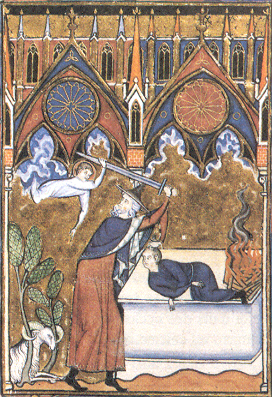
 Abraham e Isaac. Salterio de San Luis, siglo XIII (Biblioteca Nacional, París)
Many famous friendships are described within the pages of our holy book...
  • Ruth and Naomi
  • Jonathan and David
  • David and Hushai
  • Elijah and Elisha
  • Paul and Timothy
  • Jesus and His disciples
  • Moses spoke face to face with God, as with a friend
But I think my favorite has to be Abraham... for Abraham was called the friend of God. 

"The" particularly when used directly before a noun - "friend, in this case - specifies and identifies, particularly. It becomes part of a title and can mark a noun for the purpose of indicating the best-known, most approved, most important, most satisfying, etc. (Dictionary.com). Arabs and other Muslims, who consider Abraham to be one of their key ancestors, rarely use his name. Rather, they use the expression Khalil Allah, which means “Friend of God,” or El Khalil, “the Friend.” 

Thus, there was something about Abraham that first distinguished him from all the others. Look at the verbs that describe Abraham's responses to God: 
  • went forth, built an alter, pitched his tent, journeyed on... but then he went down to Egypt; 
  • went up, called on the name of the Lord, sought unity with Lot, gave preference to Lot, separated from one who lifted his eyes-saw-then chose for himself, settled in the land, lifted his eyes and saw what was given to him, rose up, walked the length, moved his tent, came and dwelt, built an altar;
  • lived in peace with his neighbors, listened to relevant information, heard that his nephew was taken captive, went in pursuit of his nephew, defeated his nephew's captor, returned him, received Melchizadek's blessing, honored God over the King of Sodom;
  • questioned God, reminded God of His promise, believed in the Lord, asked for confirmation, brought and prepared animals for sacrifice, received God's covenant - even through terrifying and dreadful moments;
  • gave Ishmael the name that means "God hears;"
  • fell on his face before God, allowed the Lord to change his name, allowed the Lord to change his wife's name, laughed when belief was hard, pleaded for Ishmael to live under God's blessing, believed and obeyed - Abraham, Ishmael and all males 13 and over were circumcised as a sign of God's covenant;
  • hospitable and honoring to holy guests, pleads for Sodom, returned home;**
  • returned to the place where he'd stood before the Lord and saw the smoke;
  • admitted responsibility to Abimelek and prayed for him and his family; 
  • named son Isaac, circumcised his son on the eighth day, listened to God in regards to Ishmael, planted a tamarisk tree in Beersheba, called upon the name of the Lord;
  • was tested by God, answered "Here I am" when God called, obeyed, willing to sacrifice his beloved son, took the knife to slay his son, answered "Here I am" when God called a second time, looked-saw-took-sacrificed the caught ram instead of his son, returned to servants, stayed in Beersheba;
  • mourned and wept for his wife, purchased land for Sarah's tomb; 
  • secured a wife for his son from his family; shared his trust in God wit those who worked with him - looking at Elimelech;
  • left everything he owned to his son, sent away the sons not of promise, left God to bless his son.
So many of these are powerful, but the one that jumps out: he "believed in the Lord." It doesn't say Abraham just believed the word of the Lord, or trusted what He said or hoped that He'd follow through on promises made. 

It doesn't say that Abraham believed the promise. 

Rather?

He believed in the Promiser.

And God called Abraham, "Friend..."

"Friend" is, as Spurgeon said: 
  1. "...a title to be wondered at... Friendship cannot be all on one side. In this particular instance, it is intended that we should know that while God was Abraham’s friend, this was not all, but Abraham was God’s friend. He received and returned the friendship of God! From one point of view, Abraham was always the object of God’s pity and mercy, but, by His Grace, the Lord also lifted him into another condition in which he became the object of the Lord’s complacency and delight..."
  2. ...a title "vindicated [because]... Abraham’s trust in God was implicit...  joined [with] a practical confidence as to the accomplishment of everything that God had promised... unquestioning... [his] desire for God’s glory was uppermost at all times... [his] communion with God was constant."
  3. "...THE title to be sought after" after full reconciliation to God, including the "mutual exercise of choice - in that the God who has chosen [me] must be chosen by [me]..." characterized by a "conformity of heart" and "continual communion... that breeds mutual delight" as I "copartner with Him."
  4. "...THE title to be utilized for practical purposes... as a great encouragement to the people of God..." and as a warning to "delight in the responsibility... thirst[ing] to be well-pleasing... aspir[ing] to dwell in Him... willing to bear anything which will make [me] one with God!"  (A sermon titled The Friend of God, #1962 - delivered on Sunday, May 8, 1887 by CH Spurgeon at the Metropolitan Tabernacle, Newington.)


Genesis 15:6
Abram believed in the LORD, and He credited it to him as righteousness.

2 Chronicles 20:7
Our God, did you not drive out the inhabitants of this land before your people Israel and give it forever to the descendants of Abraham your friend?

Isaiah 41:8
"But you, Israel, my servant, Jacob, whom I have chosen, 
you descendants of Abraham my friend...

James 2:22-26
You see that faith was working with his works, and as a result of the works, 
faith was perfected; and the Scripture was fulfilled which says, 
"AND ABRAHAM BELIEVED IN GOD, 
AND IT WAS RECKONED TO HIM AS RIGHTEOUSNESS," 
and he was called the friend of God. 
You see that a man is justified by works and not by faith alone. 
In the same way, was not Rahab the harlot also justified by works 
when she received the messengers and sent them out by another way? 
For just as the body without the spirit is dead, 
so also faith without works is dead.

*************************************************
Technically, ** (in the text above) is where 5MF stopped, so this wasn't a genuine 5MF... Once I started looking at the topic, 
I wanted to study further than five short minutes would allow.

If you want to join in, head on over to Lisa-Jo's.

12 September 2012

Walk with Him Wednesday ~ Radical Reflection

Last week, as we've been discussing the practice of habits, Ann added a very specific qualifier, encouraging us to think about how we "...practice new habits. How do we begin again every day? How do we make a fresh start every day and begin anew?..."


Last week, I finished a book that it has taken me a very long time to read - I think a friend handed it to me sometime around Christmas last year. No joke! I've been reading a bit, putting it down, thinking lots on what I read, going over what I was learning, and asking the Holy Spirit to show me things to keep, use, apply...


One area where I was challenged was in the area of self-examination (or soul-searching, contemplation, introspection, rumination, reflection, whichever word you prefer). The author, Ruth Haley Barton, divided self-examination into two broad categories: 
  1. Examining the consciousness - deliberately looking to see all the evidences of God's presence and the working of His hand throughout each day, and
  2. Examining the conscious - choosing to see myself more clearly in the light of God's unmistakable presence by embracing the gift of who and how He created me to be as well as focusing on, instead of running from, the darkness within and what having a sin nature means.


When I typed "self-examination"  into the search box on openbible.com,  57 different verses popped up; one of the first portions of God's Word listed was Psalm 139.

O LORD, You have searched me and known me.
You know when I sit down and when I rise up;
You understand my thought from afar.
You scrutinize my path and my lying down,
And are intimately acquainted with all my ways.
Even before there is a word on my tongue,
Behold, O LORD, You know it all.
You have enclosed me behind and before,
And laid Your hand upon me.
Such knowledge is too wonderful for me;
It is too high, I cannot attain to it.
Where can I go from Your Spirit?
Or where can I flee from Your presence?
If I ascend to heaven, You are there;
If I make my bed in Sheol, behold, You are there.
If I take the wings of the dawn,
If I dwell in the remotest part of the sea,
Even there Your hand will lead me,
And Your right hand will lay hold of me.
If I say, “Surely the darkness will overwhelm me,
And the light around me will be night,”
Even the darkness is not dark to You,
And the night is as bright as the day.
Darkness and light are alike to You.
For You formed my inward parts;
You wove me in my mother’s womb.
I will give thanks to You, for I am fearfully and wonderfully made;
Wonderful are Your works,
And my soul knows it very well.
My frame was not hidden from You,
When I was made in secret,
And skillfully wrought in the depths of the earth;
Your eyes have seen my unformed substance;
And in Your book were all written
The days that were ordained for me,
When as yet there was not one of them.
How precious also are Your thoughts to me, O God!
How vast is the sum of them!
If I should count them, they would outnumber the sand.
When I awake, I am still with You.
O that You would slay the wicked, O God;
Depart from me, therefore, men of bloodshed.
For they speak against You wickedly,
And Your enemies take Your name in vain.
Do I not hate those who hate You, O LORD?
And do I not loathe those who rise up against You?
I hate them with the utmost hatred;
They have become my enemies.
Search me, O God, and know my heart;
Try me and know my anxious thoughts;
And see if there be any hurtful way in me,
And lead me in the everlasting way.

These words are not unfamiliar words. Yet there is one part of this particular passage that has always confused - even disturbed - me, making me feel uncomfortable.

O that You would slay the wicked, O God;
Depart from me, therefore, men of bloodshed.
For they speak against You wickedly,
And Your enemies take Your name in vain.
Do I not hate those who hate You, O LORD?
And do I not loathe those who rise up against You?
I hate them with the utmost hatred;
They have become my enemies.

These words of imprecation just seem out of character with the rest of the psalm, at least to me, as I read it. 

Am I the only one that thinks that? 

Yet since this is God's Word... I need to try and figure out what they mean and why they are there.


My first... and maybe primary thought is that...

I find preschoolers refreshing. While they imagine and play, they don't tend to pretend when it comes to what they are thinking and feeling. They tell you what they think. I rarely have to guess about what M&M wants. She tells me with her words, her behavior and her facial expressions pretty much exactly what is going on in her heart, soul and mind. In other words, what you see is what you get. 

On the other hand, she's often clueless about herself, and can't explain why she does what she does... why she chooses disobedience or flies off in a rage and hits her sister for picking up her toys or walks around with a sour expression when she has to help put away her brother's laundry.

What does that have to do with Psalm 139?

Well, David starts off by saying: "You have searched me and known me." Then he goes on to describe the intimate totality of the Almighty's knowledge of him. Isn't that sort of like what Ms Barton (that author I mentioned earlier) means by examining our consciousness, recognizing the traces and clear evidences of God's hand and presence in our lives? The first many verses of this Psalm, penned by David, are words counted  beautiful and precious in Scripture because of the truth that God knows us better than we know ourselves, and still chose love and enormous sacrifice because of His choice. David wrote, right before he launches into that imprecatory section, these words: "How precious also are Your thoughts to me, O God! How vast is the sum of them! If I should count them, they would outnumber the sand. When I awake, I am still with You."

Then he writes words that rain judgment, asking God to visit His wrath on the wicked. Please note that I'm not trying to negate the more traditional applications of these verses, but as I read this time, I wondered, especially in the context of David writing about God's thoughts, if these verses couldn't also be a little bit of that second type of self-examination, examination of conscious, about which Ms Barton wrote. Could David be asking the Lord to reveal the dark, sinful, loathsome things within himself, of which he is unaware - and in the recognition of God's abiding presence, help David rid those things from his life? 

What if David's imprecation is not just directed towards the visible, tangible, physical enemies of God, but also the very things inherent within standing contrary to God, His character and His holiness? 

What if David's angry words are for the deep darkness that comes from a sin nature and which needs God's revelation before we are even capable of knowing and recognizing it?


In this context, the last words of this Psalm pack quite a punch. It was another one of those curious things I'd noted previously about this psalm. At the beginning, David says "searched" - past tense. So why here, at the end of the psalm, is he speaking in the present imperative? 

David's example fleshes out what God-dependent, always present and continual soul-searching and contemplation just might look like. 

Working to develop this as a daily habit might, by God's grace, make me into a woman after His own heart.


The book to which I refer in this post is  
by Ruth Haley Barton

04 July 2011

Multitude Mondays - 1000 Gifts ~ Freedom is Accepting the Challenge to Esteem Others

I don't agree with everything Nelson Mandela said... but I totally love this quote:

"For to be free is not merely to cast off one's chains,
but
to live in a way that respects and enhances the freedom of others."


Last night, at the Sunday evening service, we were challenged from 1 Peter 2 to "Honor everyone. Love the brotherhood. Fear God. Honor the king."

Both of these thoughts are complimentary ideas to contemplate this Independence Day... freedom carries with it a huge responsibility... politically and socially... but even more importantly, the liberty that Christ has won for me should compel me to treat others, specifically (according to 1 Peter) the earthly authorities God has placed over me, whether we think they deserve that honor or not. As we were looking at these verses last night, we were reminded that the "king" at the time Peter penned these words, under the inspiration of the Holy Spirit, was the Roman emperor, Nero.

Seems to me, these are timely thoughts as we are entering, once again, another election season...

And speaking of earthly authorities... it has been a joy this year to meet, on several different occasions, the American ambassador to our adopted homeland, Niger. She truly seems to love people and seeks to build relationships. Our kiddos were certainly impressed with her as they spoke with her last weekend, at the 4th of July celebrations held at the American International School Rec Center on Saturday.

Hope you enjoy the photos!

this week's gratitude list
(#s 1256 - 1284)

that I am a citizen of the United States

that I am a citizen of Heaven

reading Randy Alcorn's book, Heaven

a vibrant, energetic, friendly and personable ambassador to Niger


patriotic parades

our kids' designing and building a float for the parade - an activity that engaged and amused all week long


big bro and big sis... good sports with all this parade silliness and fun

our very own little "Miss Liberty!"


friends

picnics by the river

watching hippos

grilled dogs smothered in homemade chili and shredded cheese

sweet watermelon

chocolate raspberry mousse pie... delicious, and all the adaptations to make it work in Niger actually worked!

softball, kickball and apple pie on the fourth

catching up with friends I haven't seen for awhile

meditating on what it means to honor everyone - regardless of my feelings about any particular someone

the Holy Spirit's enabling power... for to esteem and venerate others does not come naturally nor easily

finally finding Zarma making sense

continued progress with the literacy class

an almost finished office building

19 days until they arrive

realizing that that it is OK that I'm not having much of a summer vacation, because I know I'm right where God wants me and serving as He wants me to serve

little girls... and bigger girls... wanting to exercise with a favorite "auntie"

summer nights watching movies, laughing and enjoying friends

this amazing place God has placed us - even when decent veggies are next to impossible to find in town

sleeping with the AC on... makes it feel like vacation

icy water in the cooler

reading my Bible on the back terrace, cool breeze rising from the river, butterscotch danishes baking in the oven - and kid giggles when they find that treat for breakfast

LinkWithin

Related Posts with Thumbnails